Deadlocks: What would Feynman do?
secretGeek .:dot Nuts about dot Net:.
home .: about .: sign up .: sitemap .: secretGeek RSS

Deadlocks: What would Feynman do?

deadlock info from trace 1204

When confronted with a difficult situation, I often ask myself "What would Feynman do?"

And I know that Richard Feynman, apart from being a brilliant theoretical physicist, gifted lecturer, writer, problem solver, great mind of our age, and all-round wise-guy, was also a bongo player. I don't personally own a set of bongos, but i do have a large swiss ball -- so i took to sitting on a computer chair, with the swiss ball between my knees, beating out a funky congo rhythm using two heavy winter socks as drum sticks. Just Like Feynman.

The problem at hand was deadlocking. Boom ba-da-boom. One little deadlock can ruin your whole highly-concurrent service-oriented-architecture. Boom ba-da-boom.

Deadlocks are easy to fix once you know the cause and you have the solution and it's all wrapped up and you're looking back on it later, preferably with a Singapore Sling in one hand, and an elbow propped on a bar. Listening to some groovy jazz. Tapping your foot, and smiling. Oh, there's nothing easier to fix than a deadlock. Once it's fixed.

(continues, with mystery solved)

But prior to that, a deadlock is a crushing, debilitating, nasty, ugly, painful, evil little problem. Out of the box, SQL Server gives you no help at all. The best you get is a message saying 'hey, there was a deadlock, and a particular statement was chosen as the victim'. That's it. Turning to google, I soon found some great articles from Bart Duncan: Deadlock Troubleshooting.

It turns out that you can ask for more information, by turning on particular options ("DBCC TRACEON (1204, -1)" in SQL 2000, or 1222 in SQL 2005). My deadlocking issues were in SQL 2000, so i had to use option 1204 -- and option 1204 gives you a very obfuscated little message, here's what I got:
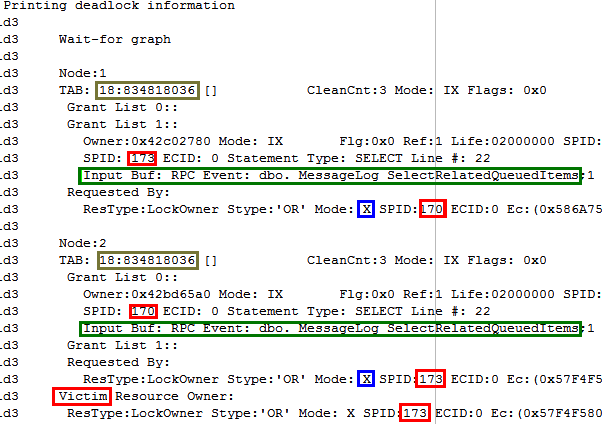
info produced by option 1204

So this turned out to be one of the simpler deadlock scenarios -- where two instances of the same stored procedure are blocking each other. How obfuscated can an error message be!

The highlighted parts of the image tell the story:

  • There was a deadlock between process 170 and 173, with 173 chosen as the victim. (this is told by the red highlighting)
  • Both 170 and 173 were trying to execute line 22 of of the sproc, "MessageLog_SelectedRelatedQueuedItems" (this is the green boxes)
  • Both processes already had an "IX" (intent exclusive) lock on the "MessageLog" table (this is explained by "TAB: 18:834818036." see below)
  • Both processes wanted to upgrade from an 'intent exclusive' lock to an actual 'eXclusive' lock. But neither process could, because of the IX lock held by the other process.

The most important parts of the message are the hardest parts to find. In particular the 'X' and the 'IX' were crucial here.

First: why does "TAB: 18:834818036." mean 'the message log table'?

Because we look at those two numbers, 18 and 834818036, and we do the following (in query analyzer):

Use master
Select * from SysDatabases where ID = 18

this returned a particular database... let's say it was called the "Message_dev" database. I performed the following:

use Message_dev

Select * from SysObjects where ID = 834818036

This returned the MessageLog table

So it's the table itself that the lock is requested on, as opposed to an index or a view, for example.

Exclusive Locks... Intent Exclusive Locks... Could you dummy it down a shade?

Look I try not to think about this stuff too much. When everything is working fine, you never have to worry about what kind of locking strategy is being used under the covers. But when deadlocks occur you suddenly want to understand everything at a very fine level of detail.

Rather than try to understand it completely from scratch, I did what every good programmer would do, and googled for an answer. The incredible Itzik Ben-Gan had helped someone with this exact problem before, so I'll quote his description:

"Technically the deadlock happens because each transaction first acquires an Intent Exclusive lock (IX) on the table and keeps it.

Typically an IX lock indicates the intent to modify rows at a lower granularity level.

Then the transaction attempts to acquire an Exclusive table lock (X); I believe that it attempts to acquire an X table lock and not go through Intent Update (IU) and Update (U) locks first because you requested to work with a serializable isolation level, and since there's no index, the way to guaranty serializable is to lock the whole table.

An IX lock is compatible with an IX lock, therefore two different transactions can acquire IX locks at the same time. But an X lock is incompatible with an IX lock, so when the timing is such that both transactions managed to acquire IX locks and then ask for an X lock, they're blocking eachother and you have your deadlock.

if you add a TABLOCKX hint, you tell SQL Server that you want to exclusively lock the whole table to begin with, so there was no need for IX locks, hence no deadlocks.

Also, The deadlock doesn't happen in read committed isolation because the transaction requests the following sequence of locks:

1. IX table
2. IU page
3. U row
4. IX page
4. X row

The key in the deadlock prevention here is that U lock is incompatible with U lock (not with previously acquired locks) so one transaction blocks the other as opposed to both blocking eachother.

So a couple of ways around the deadlocks are:
1. Use the hint
2. Use read committed isolation

A third option that I tested that seems to work is to create a clustered index on the other column. I have to start class so I can't check the sequence of lock requests that helps preventing the deadlock... I'll leave it to you... ;-)"

(see, original message here)

Okay -- i followed Ben's advice and I soon got there. I didn't use the table hint he suggested, as locking the entire table seemed like overkill. I was able to change the isolation level to read-committed. After running a lot more load-tests on the server, the deadlock didn't re-occur, so we were happy with the solution.

One thing I'm left wondering -- is there a way that SQL server will tell me what locks were applied for a given query? So I don't have to try and calculate it myself, with the margin for error/incompleteness this entails?

In any case, this was perhaps the second nastiest problem I've dealt with this year, and I thought I ought to record it somehow. Once I understood the problem fully it seemed strange that I don't hit this kind of problem more often. The fact that it only occurs under highly concurrent situations might be the only saving grace.

Anyway, time to get back to playing those drums. Bring it on Feynman.


'Mark Allanson' on Sat, 16 Dec 2006 15:56:32 GMT, sez:

You're most of the way to the ideal deadlock debugging nirvana.

I extend this further by creating two stored procedures, say, spA and spB which execute the SQL generating the deadlocks within the correct isolation level. (I generally grab the sql from a "real" execution by using SQL profiler and grabbing the two commands that deadlocked in realtime)

Once you have created these stored procedures, open up two instances of SQL server, and run the stored procedures in debug mode (right click on the sproc and select debug). Once both are running you will have two spids, one for each debug execution.

Open up a third query analyzer window, and run the following SQL..

sp_lock <spid 1>
go
sp_lock <spid 2>

sp_lock shows you all the locks that are generated by a spid. So, step through your spA debug (F11 for step into, F10 for step over etc.), and every time you step through a major portion of SQL, go back to your third query analyzer window and re-run the sp_lock queries.

This way you can see what locks are being taken out at each stage.

XLocking on a table is pretty harsh, did that MessageLog table not have an index?


name


website (optional)


enter the word:
 

comment (HTML not allowed)


All viewpoints welcome. But the right to delete any post for any reason is reserved. Don't make me do it. Aim for constructiveness. Comments may be republished, emailed to your loved ones or printed and used as toilet paper. Also, I get particularly nasty on comment spam. It's not worth even trying to post comment spam here -- your html is escaped, and your links are given a rel='nofollow'. By attempting to post a comment, you understand that if the comment is considered spam, at my absolute discretion, your IP address may be used as the target of a prolonged distributed denial of service attack. Your electricity might suddenly stop working. Your car tyres will go mysteriously flat. You will suffer permanent hairloss. Your dreams will be filled with terrifying monsters. And in any case I reserve the right to record and publish your IP address.


TimeSnapper is a life analysis system that stores and plays-back your computer use. It makes timesheet recording a breeze, helps you recover lost work and shows you how to sharpen your act.


NimbleText - FREE text manipulation and data extraction

NimbleText is a Powerful FREE Tool

Use it for:

  • extracting data from text
  • manipulating text
  • generating code

It makes you look awesome. Use it right now! Go on! Hurry! Don't walk, run!


Articles

Mind-boggling Demo of New Gaming Genre, aka Folder-Based Hangman, aka Fun with Recursion Mind-boggling Demo of New Gaming Genre, aka Folder-Based Hangman, aka Fun with Recursion
Got CSV in your javascript? Use agnes. Got CSV in your javascript? Use agnes.
I went to write down a book name and founded an internet empire instead. I went to write down a book name and founded an internet empire instead.
NimbleText: Origins NimbleText: Origins
The Windows 8 Mullet The Windows 8 Mullet
Cosby: spontaneous striped background generator Cosby: spontaneous striped background generator
Slides from WDCNZ: Live Coding Asp.net MVC3 Slides from WDCNZ: Live Coding Asp.net MVC3
MVC 3, MVC 3, "Third Times a Charm" references
Custom Errors in ASP.Net MVC: It couldn't be simpler, right? Custom Errors in ASP.Net MVC: It couldn't be simpler, right?
Anatomy of a Domain Hijacking, part 2: The Website Who Came In From The Cold Anatomy of a Domain Hijacking, part 2: The Website Who Came In From The Cold
Anatomy of a Domain Hijacking, part 1 Anatomy of a Domain Hijacking, part 1
secretGeek.net domain has been stolen. The site may go down. secretGeek.net domain has been stolen. The site may go down.
Boring article: 'untrusted domain' issue with SQL Server. Boring article: 'untrusted domain' issue with SQL Server.
Coding While You Commute Coding While You Commute
Test Driven Dentistry Is A Good Thing Test Driven Dentistry Is A Good Thing
The 'less crashy' release of NimbleText The 'less crashy' release of NimbleText
Rethinking Toolbars in Visual Studio (or any IDE) Rethinking Toolbars in Visual Studio (or any IDE)
Where shall we have lunch? Where shall we have lunch?
Setting up email for your microIsv Setting up email for your microIsv
The NO Visual Studio movement: Compiling .net projects in Notepad++ The NO Visual Studio movement: Compiling .net projects in Notepad++
ZeroOne: the editor for programmers who think in binary ZeroOne: the editor for programmers who think in binary
Mercurial workflow for personal projects (with a .net bias) Mercurial workflow for personal projects (with a .net bias)
I see you're using vim. Let me fix that for you. I see you're using vim. Let me fix that for you.
The worst recruitment spam I've ever read The worst recruitment spam I've ever read
A thank you I forgot to say A thank you I forgot to say
My new product, NimbleText, is live My new product, NimbleText, is live
Grabbing the free songs of Jonathan Coulton (with Powershell) Grabbing the free songs of Jonathan Coulton (with Powershell)
Using NimbleSet to compare lists Using NimbleSet to compare lists
Wanted: Wiki Lists (dot org) Wanted: Wiki Lists (dot org)
DOS on Dope: The last MVC web framework you'll ever need DOS on Dope: The last MVC web framework you'll ever need
JSON Query Languages: 5 special purpose editors JSON Query Languages: 5 special purpose editors
What then, is b? What then, is b?
SQLike: A simple editor SQLike: A simple editor
Yet Another BizPlan Generator. Yet Another BizPlan Generator.
HOT GUIDS: A hot or not site for guids HOT GUIDS: A hot or not site for guids
How does life get better? One tiny hack at a time. How does life get better? One tiny hack at a time.
24 things to do, and 100 things *not* to do (yet) for building a MicroISV 24 things to do, and 100 things *not* to do (yet) for building a MicroISV
Venture capital won't kill Jeff Atwood, it will only make him Jeffer. Venture capital won't kill Jeff Atwood, it will only make him Jeffer.
A handy workflow image for newbie mercurial users A handy workflow image for newbie mercurial users
Fractal Feedback, a diversion into recreational programming Fractal Feedback, a diversion into recreational programming
Hump-Jumping: How the Education of Computer Science can be Saved, err, maybe. Hump-Jumping: How the Education of Computer Science can be Saved, err, maybe.
Suggested User Experience Improvements for DiffMerge Suggested User Experience Improvements for DiffMerge
SQL Style Extensions for C# SQL Style Extensions for C#
The Movie Hollywood (And My Wife) Doesn't Want You To See: Weekend at Jacko's The Movie Hollywood (And My Wife) Doesn't Want You To See: Weekend at Jacko's
Sysi: the ultimate administrators toolkit Sysi: the ultimate administrators toolkit

Archives .: secretGeek :: Complete Archives
TimeSnapper -- Automated Screenshot Journal TimeSnapper.com    
Version 3.3: true productivity boost

Next Action NextAction
Managing the top of your mind

NimbleText -- World's Simplest Code GeneratorNimbleText -- World's Simplest Code Generator, Text Manipulator, Data Extractor

25 steps for building a Micro-ISV 25 steps for building a Micro-ISV
3 minute guides -- babysteps in new technologies: powershell, JSON, watir, F# 3 Minute Guide Series
Universal Troubleshooting checklist Universal Troubleshooting Checklist
Top 10 SecretGeek articles Top 10 SecretGeek articles
ShinyPower (help with Powershell) ShinyPower
Now at CodePlex

Realtime CSS Editor, in a browser RealTime Online CSS Editor
Gradient Maker -- a tool for making background images that blend from one colour to another. Forget photoshop, this is the bomb. Gradient Maker


[powered by Google] 


How to be depressed How to be depressed
You are not inadequate.


Recommended Reading


the little schemer


The Best Software Writing I
The Business Of Software (Eric Sink)

Recommended blogs

Jeff Atwood
Joseph Cooney
Phil Haack
Scott Hanselman
Julia Lerman
Rhys Parry
Joel Pobar
Thomas White
OJ Reeves
Eric Sink

Aggregated Links

proggit
dzone
hacker news
dot net kicks

Human Link Machines

interesting finds
a continuous learner's weblog
arjan's world
weekly link post

LinkedIn profile
LogEnvy - event logs made sexy
Computer, Unlocked. A rapid computer customization resource
PC Smart Buys - Computer Hardware in Australia
 
home .: about .: sign up .: sitemap .: secretGeek RSS .: © Leon Bambrick 2006 .: privacy

home .: about .: sign up .: sitemap .: RSS .: © Leon Bambrick 2006 .: privacy