Miscommunication Grows Faster than Communication
secretGeek .:dot Nuts about dot Net:.
home .: about .: sign up .: sitemap .: secretGeek RSS

Miscommunication Grows Faster than Communication

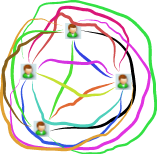
network of gossip

Something occurred to me on my bus ride home recently. As an organisation grows, the potential for miscommunication grows far more quickly than the potential for good communication.

There's a fairly well known (and debated) principle, referred to as 'the network effect' (or 'the communication explosion') which demonstrates how adding more people to a group causes the potential for communication to quickly become complex.

The 'network effect' is based on Metcalfe's law (which was originally concerned with ethernets, not social networks), and it's one of the priciples that underpins a much loved saying among programmers:

("Brooks' Law", Frederick P Brooks, 'Mythical Man Month')

The 'network effect' for social groups says that as a group grows, the potential for direct communication is in proportion to the member count, squared.

(Usually described as n*(n-1)/2. We divide by two, since each link is two way; we subtract one, since a node can't communicate with itself.)

Meanwhile, the potential for gossip, backstabbing, slander, scandal and rumourmongering grow in proportion to a factorial of the member count.

(Continues, with diagrams...)

He said, she said

Let's watch the growth in comminication and the explosion in miscommunication as a small group expands.

We'll start with a company that has two employees, Alfred and Betty. There is one avenue of communication and no avenues of miscommunication.

Now imagine a new guy, Charlie, joins. We now have three employees: Alfred, Betty and Charlie (A, B and C).

There are three lines of direct communication: Alfred to Betty, Betty to Charlie, and Charlie to Alfred.

But, suddenly, we have six potential lines of miscommunication: Alfred passes on what Betty told Charlie about him. Betty passes on what Charlie told Alfred about her.... and so on.

When Dave joins the company, we take on three more potential lines of communication (Dave can talk to any of the existing people). But the potential avenues for miscommunication has, in short time, reached a staggering figure of twenty-four! (i think..)

After I left uni, I hit the reset button on the part of my brain that learnt about permutations, combinations and so on. But i'm pretty sure there's a factorial at work here. I'd like to see the actual equation, maybe have it printed on a t-shirt.

Surviving the Organisation

A number of organisational effects exist in any organisation, some explicitly, some implicitly. These structures include things like sub-groups, dominance and subservience, ranking (chain of command), class-systems (or even Castes), cliques, competitive teams and so on. I think the reason why these effects develop is not that it protects the group from "communication explosion."

A far stronger effect is "The Gossip Explosion" which, if left unchecked, would destroy any significantly large group.

Anyway, here's a cute summary of the miscommunication effect:


Related/Referenced Stuff


'optionsScalper' on Mon, 06 Feb 2006 05:37:19 GMT, sez:

Mr. secretGeek,

While I don't disagree with your motivation, i.e. the introduction of miscommunication is a problem, I think that there is more information that can be provided regarding your coverage. IMHO, this is a difficult topic and your post provides some basic coverage, but leaves the reader to a conclusion that I don't believe is accurate. My interest is another perspective, i.e. I'm not trying to bash away at your information, but add to it. My apologies if I'm imprecise as the comment space here is for brief commentary (and I've already violated that "brief" term).

This is a topic covered in Computer Science, under Computational Complexity and specifically Communications Complexity and a good reference may be found here:

http://www.amazon.com/gp/product/0521560675

Mitzenmacher and Papadimitriou (in two separate books) also cover the basics of this issue.

Metcalfe's law is generally considered flawed in communications circles. The Odlyzko & Tilly paper (linked on the wikipedia page) provided a framework for the estimate of the overestimate (yikes) in Metcalfe's law.

Consider for a moment that the description of this problem falls under graph theory and that the measurement for "miscommunication" is a worst-case algorithm, i.e. measured using big-O notation. In other words, what is the absolute worst possible scenario for miscommunication under these measurements?

This is merely a directed graph.

The practical limits for this problem are apparent when you consider the cost to "send" the miscommunication. If the worst case measure is used, that means that the path and endpoints (vertices and directed edges) are all "populated". Imagine now, how many of these "bad messages" must be sent. If the process is automated through email, then the task is left to computers and the network and the only "real" cost is the cost to construct and originate the "bad message". That, and then read every "bad message" to get the miscommunication. If the model is one originater with the network incurring the cost to distribute, then there are only n messages to read (for n participants) and the email inbox will contain a significantly larger number of them because of the graph paths. If the "bad message" is to go out to each participant, through each path, then the number of messages to construct is the factorial that you mention. In either scenario, there is a practical limit to either message origination or message consumption (and like you, I'll avoid the math purposely here; I'm probably scaring people away with this comment).

This second description of the problem as I list it is known to be NP-Complete and is as difficult as you describe.

In my personal opinion, I disagree with Clay Shirky, but there is empirical evidence that can dispute both sides of the arguments that he makes. While much of Shirky's work is easy to understand, I (and I'm not alone in this) find a great deal of it misleading and imprecise. Conclusions are drawn against data that doesn't support hypotheses.

IMHO, Brooks Law again works because the small group, i.e. project teams with small numbers of members are affected by uninformed participants that do, in fact, move the distribution for work accomplished to the worst case measurement. These facts should be separated, i.e. Brooks Law is "true" because adding new members makes for the worst case in each directed edge in the graph and has a higher "opportunity" to actually construct these edges.

I don't want to show up here, say "hey, this is all wrong". I'm just trying to dig a little deeper on a difficult topic. I hope this helps provide more information.

---O

p.s. I'd expect that this comment doesn't even pass the toilet paper test in your disclaimer.


'leon' on Mon, 06 Feb 2006 19:31:40 GMT, sez:

cheers optionsScalper,

nah i'm not going to flush your response -- you're quite right.

because a factorial would greatly overstate the real case (particularly for larger groups), i've carefully used the word "potential for miscommunication" -- rather than simply "miscommunication".

and yes, metcalfe's law doesn't hold for social groups large than (i'd guess) about six or seven members. to try and concede this fact i said "a fairly well known (and debated) principle".

i figure that since metcalfe's law is an overstatement of the case (really a statement of the maximum theoretical potential) for direct communication i may as well show the equivalent overstatement of the case for miscommunication.

a simple example of why its an overstatement is that it treats the following two gossip channels as equally likely and significant:
the CEO tells the third-in-charge that the second-in-charge is a thief.

The ceo tells the janitor that the third-in-charge thinks a middle-manager told him that the other janitor was told that the photocopy girl believes the second-in-charge is a thief.

i'll stand by the idea that there is a much faster growth in potential *mis*communication than in potential direct communication. in small organisations, the maximum case is achievable for both.

in larger organisations methods (direct and indirect) stop both forms of communication from reaching their limit -- but they level out in different places. The potential is still there.

i think if you look at actual miscommunication in a workplace, you wouldn't want to look at 'email' (i know you were just using that as an example) or even 'He said, she said' type gossip.

i think that much subtler forms of interpersonal communication are where the misinterpretation is conveyed quickest and travels fastest. a wink, a smile, body language -- all of those subtle, instant, and untraceable forms of communication. Email, on the other hand is accountable to some extent (somehow, flame wars still happen...).

thanks for the response! glad to see some deep thought! i remember that stuff from my youth...

cheers
lb


name


website (optional)


enter the word:
 

comment (HTML not allowed)


All viewpoints welcome. But the right to delete any post for any reason is reserved. Don't make me do it. Aim for constructiveness. Comments may be republished, emailed to your loved ones or printed and used as toilet paper. Also, I get particularly nasty on comment spam. It's not worth even trying to post comment spam here -- your html is escaped, and your links are given a rel='nofollow'. By attempting to post a comment, you understand that if the comment is considered spam, at my absolute discretion, your IP address may be used as the target of a prolonged distributed denial of service attack. Your electricity might suddenly stop working. Your car tyres will go mysteriously flat. You will suffer permanent hairloss. Your dreams will be filled with terrifying monsters. And in any case I reserve the right to record and publish your IP address.


TimeSnapper is a life analysis system that stores and plays-back your computer use. It makes timesheet recording a breeze, helps you recover lost work and shows you how to sharpen your act.


NimbleText - FREE text manipulation and data extraction

NimbleText is a Powerful FREE Tool

Use it for:

  • extracting data from text
  • manipulating text
  • generating code

It makes you look awesome. Use it right now! Go on! Hurry! Don't walk, run!


Articles

Just Wally Just Wally
The Correct Order for a First Time Viewing of The Lord Of The Rings The Correct Order for a First Time Viewing of The Lord Of The Rings
A new era for Android. A new era for Android.
Mind-boggling Demo of New Gaming Genre, aka Folder-Based Hangman, aka Fun with Recursion Mind-boggling Demo of New Gaming Genre, aka Folder-Based Hangman, aka Fun with Recursion
Got CSV in your javascript? Use agnes. Got CSV in your javascript? Use agnes.

Archives Complete secretGeek Archives

TimeSnapper -- Automated Screenshot Journal TimeSnapper: automatic screenshot journal
NimbleText -- World's Simplest Code Generator NimbleText: Code Generator, Text Manipulator, Data Extractor

25 steps for building a Micro-ISV 25 steps for building a Micro-ISV
3 minute guides -- babysteps in new technologies: powershell, JSON, watir, F# 3 Minute Guide Series
Universal Troubleshooting checklist Universal Troubleshooting Checklist
Top 10 SecretGeek articles Top 10 SecretGeek articles
ShinyPower (help with Powershell) ShinyPower
Now at CodePlex

Realtime CSS Editor, in a browser RealTime Online CSS Editor
Gradient Maker -- a tool for making background images that blend from one colour to another. Forget photoshop, this is the bomb. Gradient Maker


[powered by Google] 


How to be depressed How to be depressed
You are not inadequate.


Recommended Reading


the little schemer


The Best Software Writing I
The Business Of Software (Eric Sink)

Recommended blogs

Jeff Atwood
Joseph Cooney
Phil Haack
Scott Hanselman
Julia Lerman
Rhys Parry
Joel Pobar
Thomas White
OJ Reeves
Eric Sink

Aggregated Links

proggit
dzone
hacker news
dot net kicks

Human Link Machines

interesting finds
a continuous learner's weblog
arjan's world
weekly link post

LinkedIn profile
LogEnvy - event logs made sexy
Computer, Unlocked. A rapid computer customization resource
PhysioTec, Brisbane Specialist Physiotherapy & Pilates
 
home .: about .: sign up .: sitemap .: secretGeek RSS .: © Leon Bambrick 2003 .: privacy

home .: about .: sign up .: sitemap .: RSS .: © Leon Bambrick 2003 .: privacy