Mega-Million Dollar Idea: Diamonds@Home
No doubt you've heard of the SETI project and the Folding@Home project -- both of which let home computers act as nodes in a gigantic grid computing effort to mine information out of massive data sets. Well I've come up with a different idea for an @Home project. First, let's talk about diamonds. How are diamonds formed? The simple versionLiquid diamond forms when carbon is melted and compressed by over 45000 atmospheres of pressure. This occurs naturally at around 200 km below the earth's surface. If the temperature and pressure are quickly dropped to surface values, then the liquid diamond will cool into diamond crystals: valuable gemstones. If the temperature or pressure drop too slowly then the carbon will form relatively worthless graphite instead. There is a geological structure in which a jet of liquid diamond from deep below the earth can suddenly erupt up to the surface of the earth, thus cooling and losing pressure very rapidly, resulting in diamonds, not graphite. These jewel encrusted, diamond tipped jets of carbonaceous gas and ore are known as Kimberlite pipes, named after the town of Kimberly in South Africa, where a diamond rich kimberlite pipe was discovered, sparking a mad diamond rush in the ninteenth century. Precious needle in a massive haystackAlthough it is over 200 kilometres deep, a kimberlite pipe might be only 100 to a 1000 metres wide at the earth's surface. Furthermore, not every kimberlite pipe contains diamonds. Some estimates say that only 1 in every 200 pipes contains the girl's best friend. But given the enormous value of those that do contains diamond, it's worth sampling them all. So, Diamonds@Home... Here's where rough science ends and pure speculation begins: Imagine a neural net that carefully analyses images from google earth. If sufficient training data is available, and sufficient grid computing power, perhaps such a system could identify hundreds of potentially diamond-rich sites throughout the world. Rather than volunteering your spare computer cycles to help cure cancer (folding@home) or discover alien life (seti), you could use it to selfishly aim to become mega rich and fat with bling. This would benefit humanity how?Very little! It would lead to more ugly opencut mines, would fuel man's vain greed, and ultimately flood the diamond market. But maybe, if anyone is hoping to write a science fiction novel, it might be a nice pasttime for a megalomaniac criminal genius? Or not.
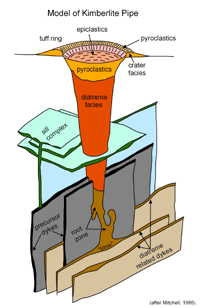
(image courtesy of yoinked from Geological Survey of Namibia)
'dysfunctor' on Sat, 09 Feb 2008 08:45:00 GMT, sez: If you took the training data from Google Earth and known locations of diamond mines, you'd end up with a neural net trained to recognise mineworks.
'lb' on Sat, 09 Feb 2008 08:50:26 GMT, sez: very true dysfunctor [who won't get his site working again until knowing.net achieves same...]
the trick is to train it on pictures of said sites from before the mining or even the investigation began. so training of said neural net is not a google earth related activity. though it could be distributed if need be.
i wonder if such pictures can be obtained? the kimberly mine predates satellite pictures for example.
'Barry Kelly' on Sat, 09 Feb 2008 20:23:56 GMT, sez: To the best of my (trivia) knowledge, the diamond market would already be pretty much flooded, if it weren't for monopoly powers on the part of De Beers etc.
On the other hand, this would be a good buyout strategy. De Beers would be forced to purchase to maintain the monopoly.
-- Barry
'mike' on Sun, 10 Feb 2008 00:41:56 GMT, sez: This is so great. Blofeld hires Russian hackers to use spam to put Kimberlite-finding malware on billions of users' computers. Bond (and pretty girl) foil the plot by pressing a big computer button (36-pt type) that deploys a Windows patch. ("No, Mr. Bond, I expect you to click this phishing link.")
'Chad' on Mon, 11 Feb 2008 17:09:18 GMT, sez: I'm with you up to the point where an end user would run this willingly on their computer.
With Seti you can reasonably assume that we aren't going to find "little green men" so you are doing it for fun or an altruistic reason.
With protien folding, you are actually assisting in cancer research, so you get a nice "I helped" feeling.
When there is REAL MONEY on the line all the sudden people get selfish. Everyone is going to want a "cut" of the money.
'rkyle' on Thu, 14 Feb 2008 19:09:18 GMT, sez: Why be specific to dimonds? There are other precious jewels and metals being taken from our dear mother earth every day. I know of several properties of interest in Alaska where no one has broken ground, yet the exploration and the permitting process has been either initiated or completed. Use these as parts of your training set. Find others just by scanning the permit requests submitted to the appropriate government regulation agencies. In 5-10 years (depending on the average time for mine development) you could have a decent data set including pics of pre and post mine operations. Then by following the press releases for the specific mining companies you can correlate the projected richness of the deposit.
'rkyle' on Thu, 14 Feb 2008 19:12:28 GMT, sez: Diamonds, NOT dimonds. Sorry, but there is a local wealthy family named Dimond and I've never grown out of the habit of misspelling the word after seeing it all over my hometown.
'http://' on Thu, 13 Mar 2008 16:55:24 GMT, sez: awsome!!!
'http://' on Thu, 13 Mar 2008 16:55:54 GMT, sez: i love this !!!!!!
'JAC' on Fri, 09 May 2008 10:07:56 GMT, sez: Ever wonder how a diamond is cut and polished? Check out this great video...
http://www.eurostardiamond.com/diamonds/index.html
'http://' on Fri, 06 Nov 2009 02:05:21 GMT, sez: check out this new reality show that is about to start there casting process. i contacted them and they said that they will open casting this weekend. www.alluvialtv.com
|